
Ying Hung Banquet (Red Banquet): Meaning, Origins, Red Envelopes, Attire & Taboos
The Ying Hung Banquet is the final stage of the funeral process, marking the formal end of the mourning period and the family's return to normal life. As modern funeral rites have been simplified, some family members or younger generations may confuse the Ying Hung Banquet with the Jie Hui Banquet (Cleansing Banquet). This article explains the definition and historical origins of the Ying Hung Banquet, along with its dress code, lai see (red envelope / lucky money) distribution guidelines, and taboos to observe during the banquet, to ensure the ceremony follows traditional etiquette.
Must a Ying Hung Banquet be held? Historical origins of the Ying Hung Banquet
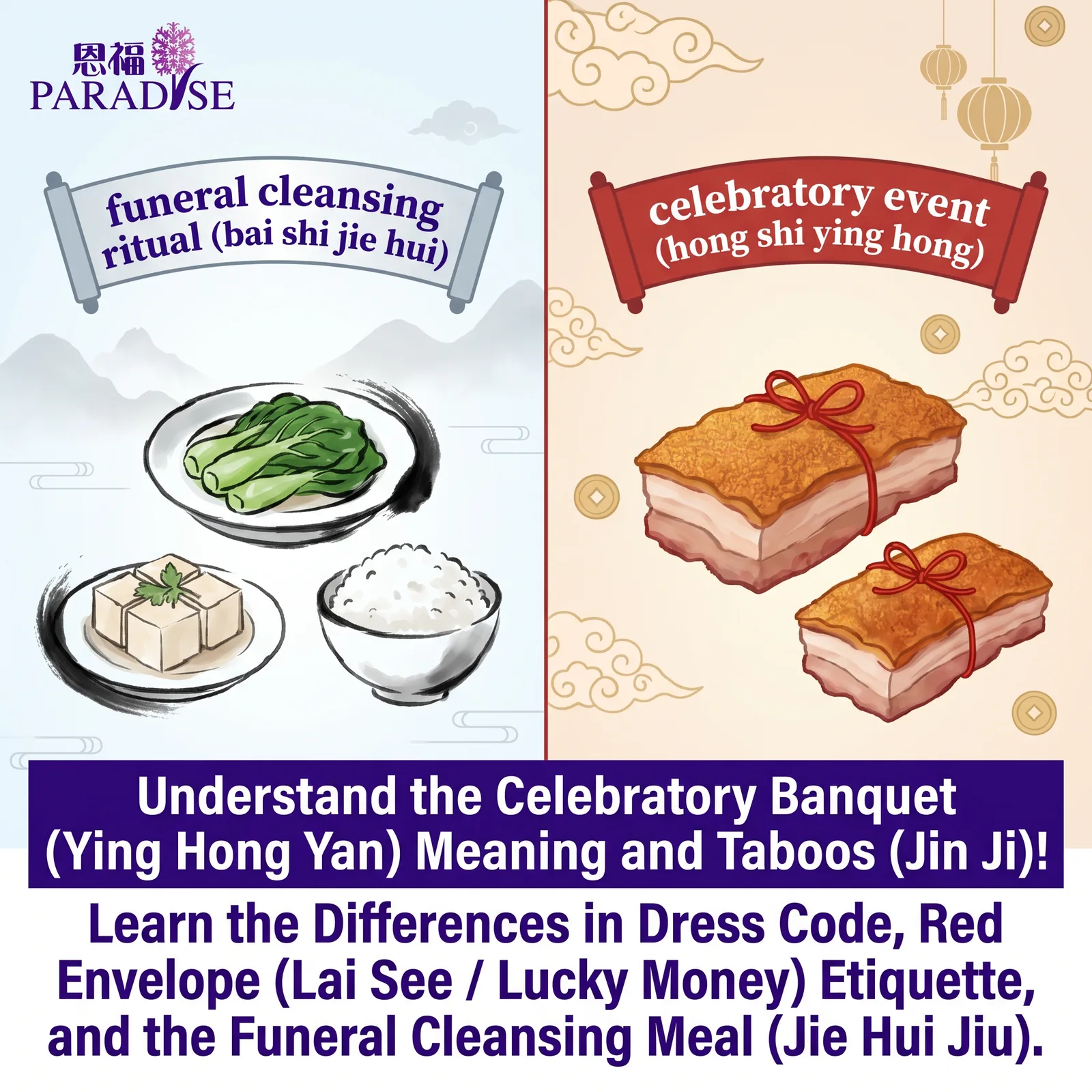
The purpose of the Ying Hung Banquet is to symbolize the family's completion of funeral rites and the formal removal of mourning garments. It is often mistakenly called the "Hero Banquet" (Ying Xiong Yan), but the correct term is "Ying Hung Banquet." The character "Ying" (纓) originally refers to the straps tied to a crown or around the neck, while "Hong" (紅) represents the auspicious color red. In traditional rites, after all funeral ceremonies (coffining, funeral procession, cremation, or burial) conclude, the family performs the "Zan Hua Gua Hong" (pinning flowers and hanging red) ritual, tying red ribbons, red flowers, or cypress leaves on their bodies or hair, signifying they have left the sorrow of mourning behind and transitioned from yin to yang — hence the name "Ying Hung."
According to traditional rites, the family typically had to wait until the 49-day or 100-day mourning period ended and remove their mourning garments before hosting a banquet for relatives and friends; only then was it considered a formal Ying Hung Banquet. However, given the fast pace of modern life, the "same-day removal of mourning" arrangement has become common. This practice condenses the formerly months-long mourning rites into a single day: after the deceased's cremation or burial, the family immediately changes out of funeral attire and holds the Ying Hung Banquet. This approach not only preserves traditional respect for the deceased but also suits the practical needs of society.
The core value of the Ying Hung Banquet lies in symbolizing the complete conclusion of farewell rites and mutual support and comfort among the living, rather than the banquet format itself. Therefore, whether to hold or attend one can be handled flexibly based on circumstances — for example, replacing it with a simple meal or arranging a family gathering at a later date are equally acceptable.
Differences between the Ying Hung Banquet and the Jie Hui Banquet
The Jie Hui Banquet is usually held during the funeral period (e.g., after the wake (overnight vigil before the funeral) or before the funeral procession). At this time, the deceased has not yet been cremated or buried, the family still wears mourning garments and remains in a state of mourning. Therefore, the menu follows the "eat seven" rule — seven dishes (odd numbers belong to yin), mostly vegetarian, accompanied by sweet soup made with brown sugar or slab sugar, symbolizing the dispelling of sorrow.
In contrast, the Ying Hung Banquet can only be held after all funeral rites have concluded, the family has completed "removal of mourning" and changed into regular attire. This banquet symbolizes the transition from yin to yang and the perfect completion of meritorious rites (Buddhist/Taoist chanting ceremonies), so it follows the "eat eight" rule — strictly requiring eight dishes (even numbers belong to yang). The menu must include roast meat symbolizing "ruddy complexion and robust health" and desserts sweetened with white sugar (such as red bean soup), symbolizing life's return to sweetness.
Dress code for family and guests at the Ying Hung Banquet
Although the Ying Hung Banquet marks the end of funeral matters, it follows immediately after the funeral, so its atmosphere must remain solemn:
Family's change of attire

Plain, elegant everyday wear: The family typically removes their mourning garments before arriving at the restaurant or in a designated space arranged by the venue, symbolizing the formal end of the mourning period. Although the term "Ying Hung Banquet" contains the word "red," the attire should not immediately switch to bright red, fluorescent colors, or overly festive outfits, to avoid an abrupt emotional transition. It is recommended that the family change into neat, casual wear in subdued tones such as dark blue, dark gray, pure white, or khaki, maintaining a dignified and appropriate appearance to show respect for the deceased and mark the transition.
Pinning flowers and hanging red ritual: After changing, the family tidies their appearance and performs the "Zan Hua Gua Hong" (pinning flowers and hanging red) ritual. Following traditional custom (typically men on the left, women on the right), they wear red flowers, red cords, or cypress leaves on their chest or hair, signifying the removal of impurity and return to auspiciousness, and a return to daily life.
Guests' dress etiquette

Avoid all-black solemnity: The Ying Hung Banquet atmosphere differs from the funeral hall. Before entering, guests must remove all funeral-specific lapel flowers or black armbands. It is suggested to remove dark outerwear or pair with softer-toned accessories to visually separate from the heaviness of the funeral venue, aligning with the banquet's ritual meaning of "removing impurity and turning to auspiciousness."
Style taboos: Ying Hung Banquet attire must avoid overly revealing clothing (e.g., miniskirts, backless tops), ripped jeans, or hip-hop style outfits. Even in summer, men should preferably wear long trousers, and women's skirts should be knee-length or longer.
Footwear: Avoid wearing bright red shoes, and do not wear flip-flops or sandals to the banquet — this is impolite at any formal banquet.
How much for the Ying Hung lai see? Ying Hung Banquet lai see envelope format, amount, and distribution rules
During the Ying Hung Banquet, the family distributes lai see to attending guests, commonly called "Ying Hung lai see." This is completely different in nature from Lunar New Year lai see, and handling Ying Hung Banquet lai see has specific rules:
Must lai see be distributed at the Ying Hung Banquet? Meaning of the Ying Hung lai see
After the family completes the removal-of-mourning ritual, to thank relatives and friends for accompanying them through the final journey and to wish everyone the washing away of bad luck and good health, they distribute these lai see envelopes. They symbolize bringing auspiciousness and good fortune to guests, dispelling the gloomy atmosphere from prior contact with the funeral.
Contents of the lai see envelope
Cash: The amount is typically an even number (e.g., two dollars, twenty dollars, etc.), taking the meaning of "good things come in pairs," opposite to the odd-numbered amounts of condolence money.
Auspicious items: Traditionally, coins (symbolizing completeness), candies (symbolizing a sweet start), tea leaves, or needle and thread were placed inside; nowadays this is often simplified to just one coin and one candy.
How to handle the red envelope (lai see / lucky money) after receiving it?
Open and use immediately: Traditional custom suggests this red envelope (lai see) is a 'good omen' and should be opened before going home (or within the same day).
Spend the cash: The cash inside should be spent as soon as possible, buying something to eat or drink, symbolizing 'eating' the blessings into your stomach or circulating the good fortune outward — do not take it home to save.
Do not bring the red envelope home: After opening, the red envelope should be discarded in a bin at the restaurant or on the street, not brought home.
Taboos and essential etiquette for the ying hung banquet (post-funeral celebratory meal)
Although the atmosphere of the ying hung banquet is more relaxed than the funeral, there are still many taboos that must be strictly observed to avoid bad luck or offending the bereaved family:

Food and dietary taboos
Roast meat is mandatory: As mentioned earlier, the ying hung banquet must include 'red-skinned, robust' roast meat, symbolizing yang energy and health. If the menu lacks this dish, it does not meet the ritual requirements.
Avoid specific ingredients: Legend holds that Ox-Head and Horse-Face are underworld officers; to prevent the deceased from suffering in the afterlife, the ying hung banquet does not serve beef or horse meat, so as not to offend the spirits.
Fruit taboo: The ying hung banquet forbids eating 'gua' (melon) fruits (such as watermelon, honeydew), because 'gua' in Cantonese carries a connotation of death (e.g., 'gua lou chun' — to die).
Behavioral and verbal taboos
Strictly forbidden to say 'goodbye': When leaving at the end of the banquet, never say 'goodbye' to relatives or the bereaved family. In this context, saying 'goodbye' carries the inauspicious implication of 'see you at the next funeral.' A simple nod, or saying 'take care' or 'all the best,' is sufficient before turning to leave.
Do not serve food to each other: While serving dishes to others is a sign of warmth at ordinary gatherings, traditional belief holds that the action resembles the 'bone collection' (exhumation and gathering of remains) ritual after cremation, so one should avoid serving food to others.
Avoid taking leftovers home: Although avoiding food waste is a virtue, the food at the ying hung banquet is meant to dispel bad luck — eating it brings blessings. One should finish the food on site; taking leftovers home may bring 'undispelled bad luck' into the house, especially bone-in dishes, which should especially not be packed up.
Taboos regarding topics of conversation
Taboos at the ying hung banquet also include avoiding excessive laughter, loud noise, and overly happy or exciting topics (such as winning the lottery, promotions), as these can be psychologically distressing to the newly bereaved and appear lacking in empathy. Conversation should be kept to positive, comforting, or casual everyday topics.
Paradise (恩福) provides professional funeral services for you
Above we have introduced the dress code for the ying hung banquet, the guidelines for distributing red envelopes (lai see), and the taboos to observe. By understanding the origins of the ying hung banquet, we grasp the profound meaning of its 'transition from white to red.' Amid the clinking of cups and chopsticks, though the loved one has passed, the family's bloodline and bonds continue to flow. As the final chapter of the funeral, the ying hung banquet signifies not just a meal, but a complete farewell from the living to the departed on their final journey, while also blessing the living to compose themselves and start anew.
Arranging a funeral involves numerous traditional rites and taboos, from the ceremonial process to the details of the ying hung banquet — all must be handled with care to show respect. If you seek professional, thorough guidance during the preparations, Paradise (恩福) is here to offer sincere assistance. We have extensive funeral experience and are dedicated to planning dignified, fitting farewells for families, with transparent, clear pricing, helping you manage after-death affairs so the deceased may rest in peace and the living have no lingering worries. For more details on funeral services or professional advice, please call 9456 8292 now to contact us for more information.

Comments