
Repatriating a Foreign Domestic Helper's Remains from Hong Kong: Process, Documents & Timeline
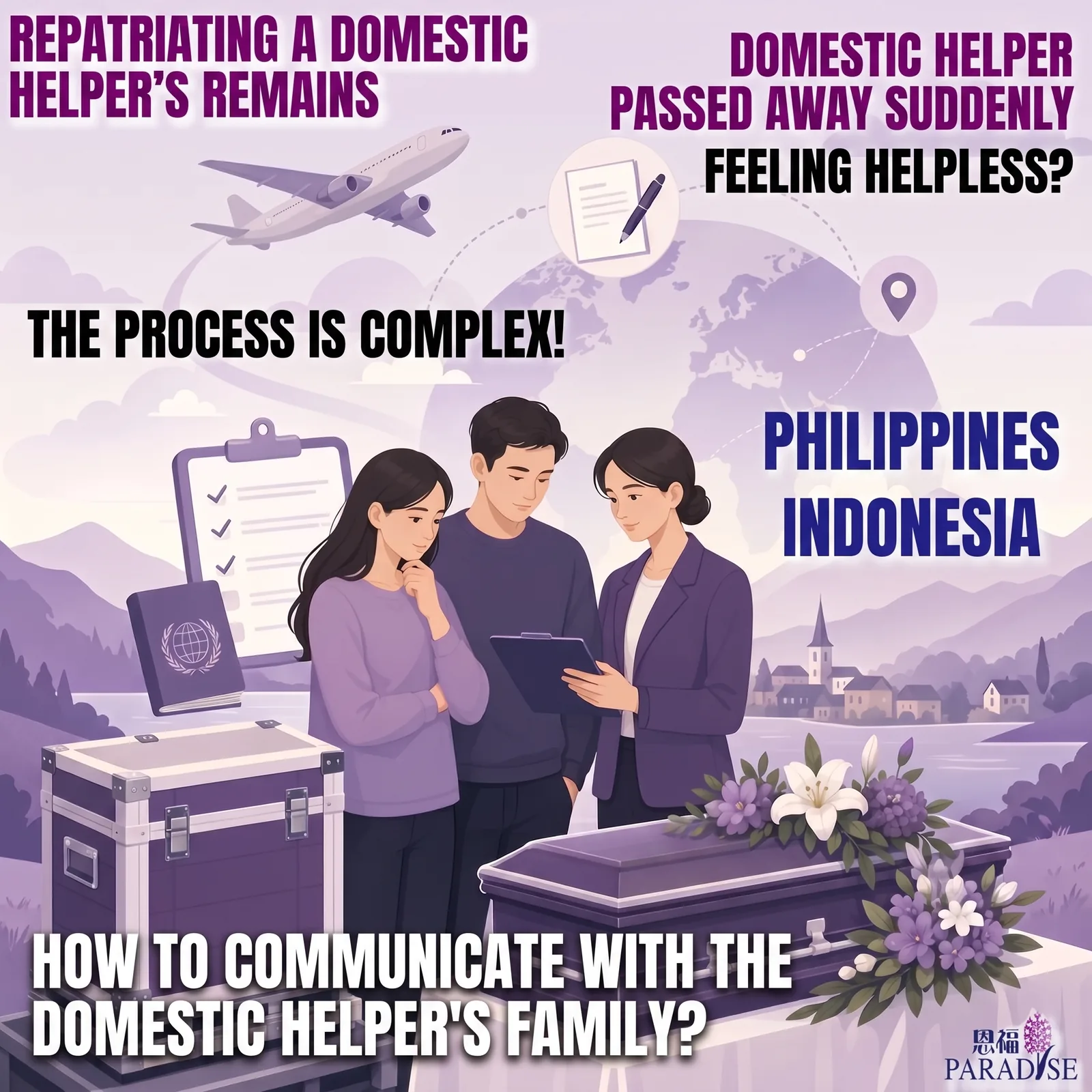
When a domestic helper suddenly passes away in Hong Kong, employers often find it both shocking and overwhelming. Beyond the emotional impact, they must handle a series of practical matters within a short timeframe, including documents, costs, and how to arrange for the body to be repatriated to the home country. Many employers feel confused at this time: who is responsible? How long does the process take? Will incomplete documents cause delays? In fact, by understanding the basic steps and entrusting an experienced funeral company, the entire process can be completed in an orderly manner, reducing unnecessary stress and time loss.
This article takes a practical approach to provide employers with a comprehensive overview of the one-stop process, required documents, and timeline for repatriating a domestic helper's remains, giving you a clear reference to follow when needed.
1. What does a one-stop domestic helper repatriation service include?
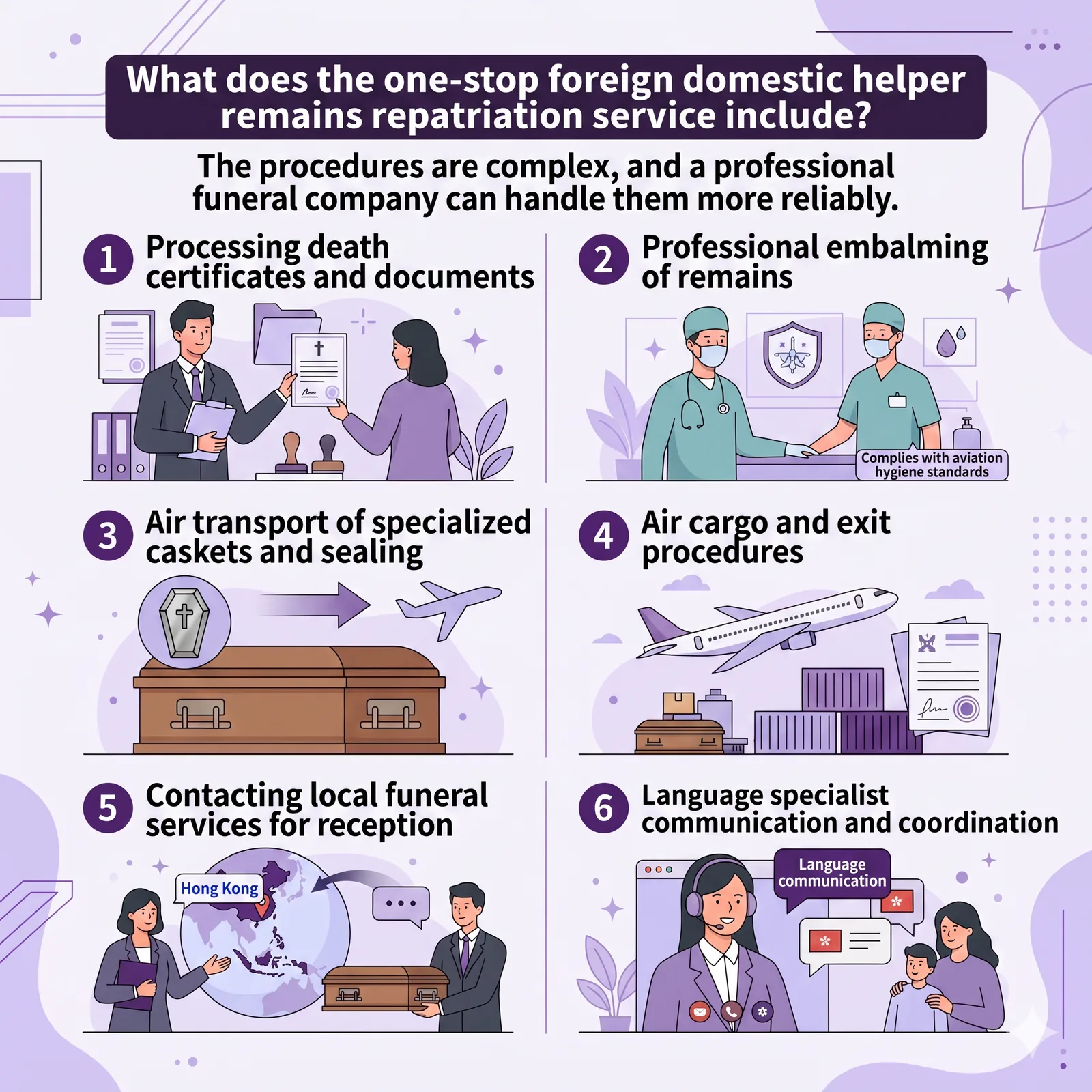
Generally, domestic helper repatriation involves multiple departments and procedures, making it quite complex for individuals to handle. Therefore, most cases are entrusted to a funeral company for one-stop handling, mainly including:
Obtaining the death certificate and related documents in Hong Kong.
Arranging embalming of the body (must meet airline and health requirements).
Providing an air cargo coffin and sealed packaging (must include a metal inner liner).
Handling air cargo declaration and exit procedures on your behalf.
Coordinating with a local funeral company at the destination to receive the body.
Assigning a dedicated multilingual coordinator to communicate with the helper's family.
If the helper's family is not in Hong Kong, or the employer cannot spare the time to handle matters, entrusting a one-stop service is more secure and can avoid delays due to document errors or omissions.
2. What is the overall process for domestic helper repatriation?
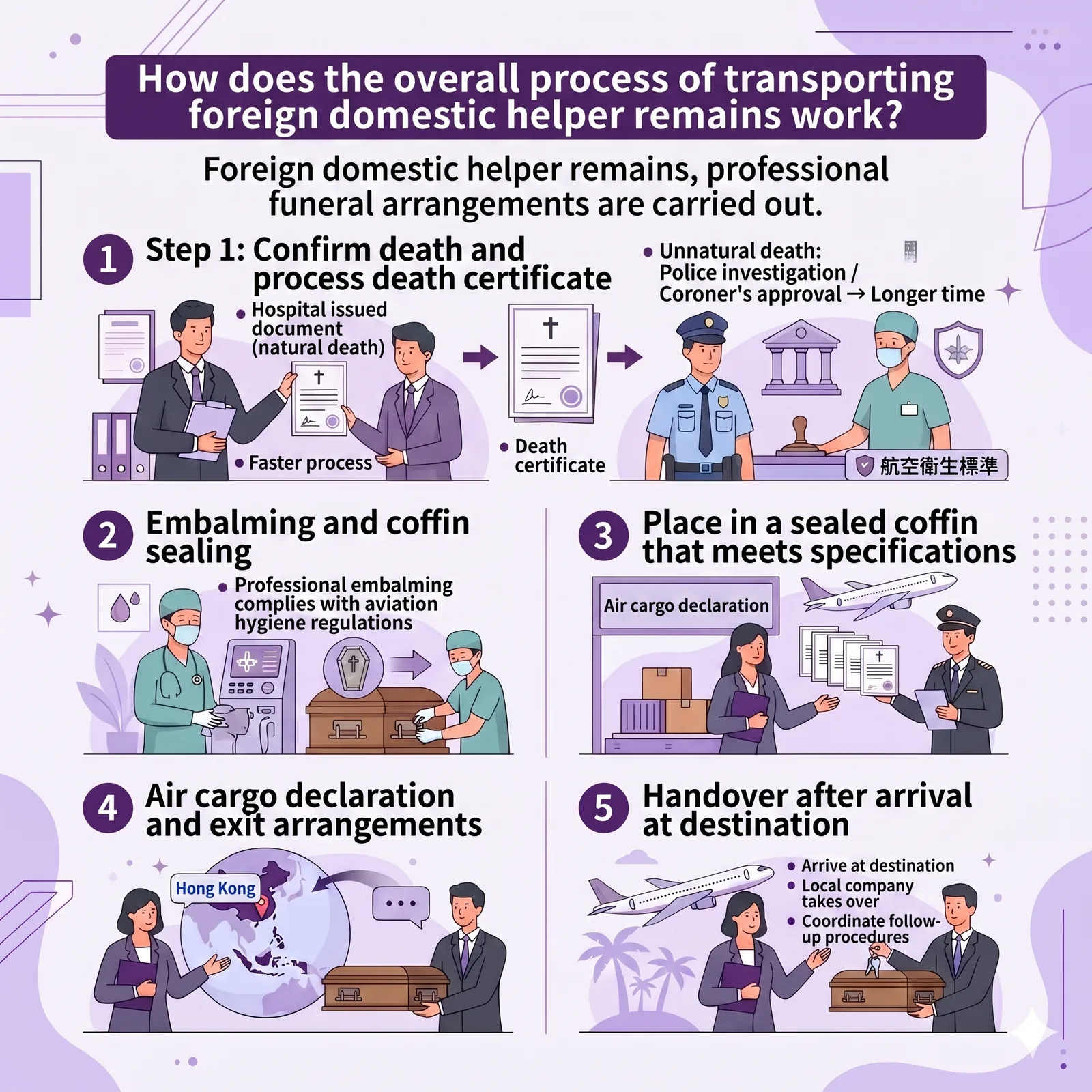
Step 1: Confirm death and obtain death certificate in Hong Kong
The cause of death must be confirmed and official proof obtained.
In the case of natural death, the hospital generally issues the documents, and the process is faster.
In the case of unnatural death, the police must investigate, and the Coroner decides whether an autopsy is required. The process and timeline are relatively longer, pending the issuance of relevant documents by the forensic pathologist and the Coroner's Court.
Step 2: Embalming and coffin sealing
All bodies transported by air must undergo professional embalming and comply with international airline and destination country health regulations.
After embalming, the body is placed in a specification-compliant sealed coffin (usually including a metal inner liner).
Step 3: Air cargo declaration and exit arrangements
Before the helper's body can exit, multiple documents must be submitted, mainly including:
Death certificate.
Qualified embalming certificate.
No infectious disease declaration.
Permit for removal of body from Hong Kong.
Authentication or relevant documents issued by the relevant country's consulate in Hong Kong.
The funeral company will coordinate cargo arrangements with the airline and handle Hong Kong Customs exit procedures on your behalf.
Step 4: Handover after the foreign domestic helper's body arrives at the destination
After the body arrives at the destination, a local funeral company must take over and arrange subsequent matters. Requirements vary slightly by country; the service team generally coordinates these in advance.
3. How does the funeral company coordinate the four parties during the foreign domestic helper's body transportation process?
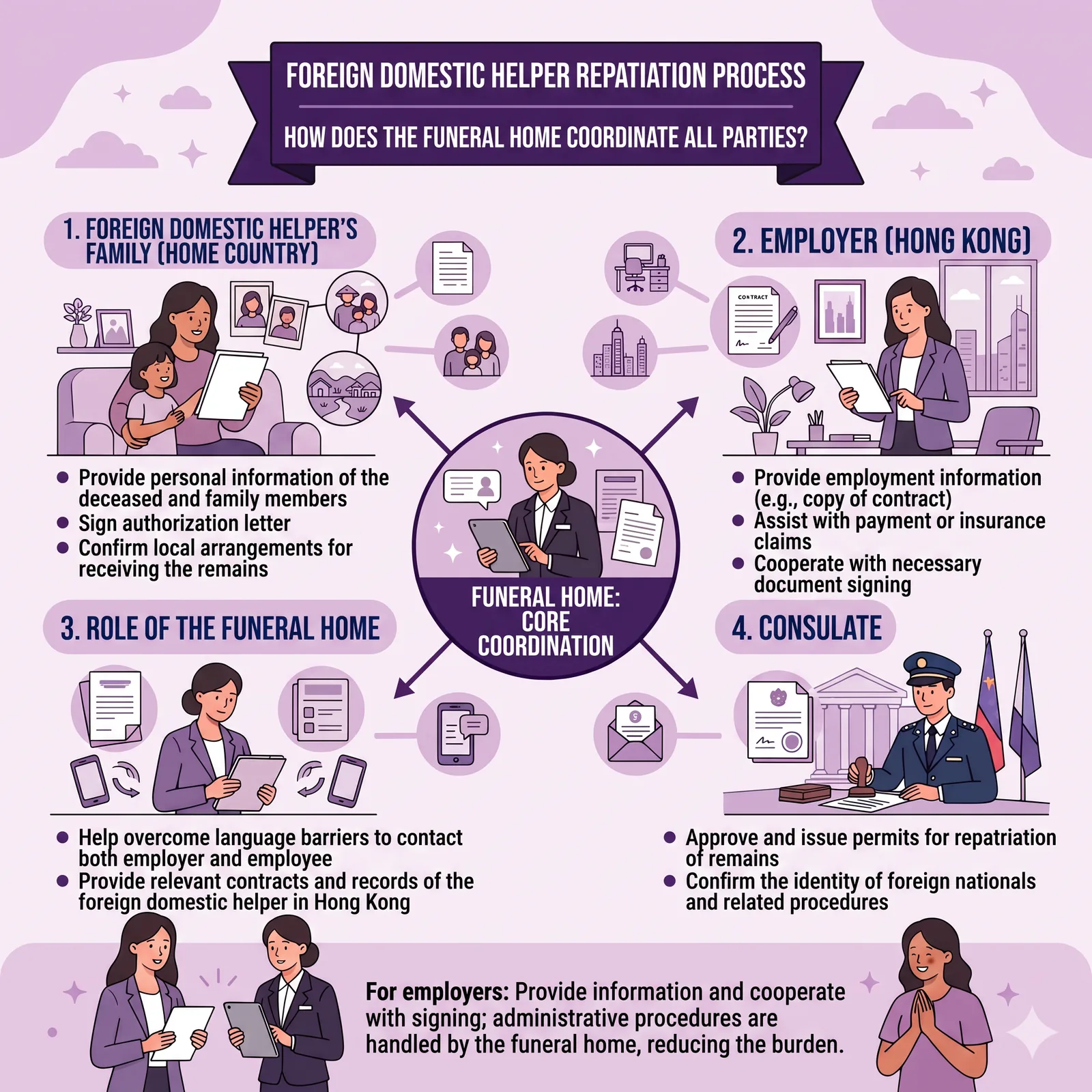
HandlingTransportation of foreign domestic helper's body, often requires close cooperation among four parties. Below are the main roles and responsibilities of each party:
Roles and main responsibilities of each party
Role | Main responsibilities |
|---|---|
Foreign domestic helper's family (home country) | Provide deceased's and family's personal information, sign authorization letter, confirm local body reception arrangements. |
Employer (Hong Kong) | Provide employment information (e.g., contract copy), assist with payment or insurance claims, cooperate with necessary document signing. |
Funeral company | Assist in overcoming language barriers to contact both employer and employee, provide foreign domestic helper's relevant contracts and records in Hong Kong. |
Consulate | Review and issue permit documents required for body repatriation, verify foreign national's identity and related procedures. |
For the employer, the actual parts requiring handling in foreign domestic helper body transportation are mainly providing information and cooperating with signing; remaining administrative procedures can be handled by the funeral company, reducing the burden.
4. How long does foreign domestic helper body transportation generally take from notification to body departure?
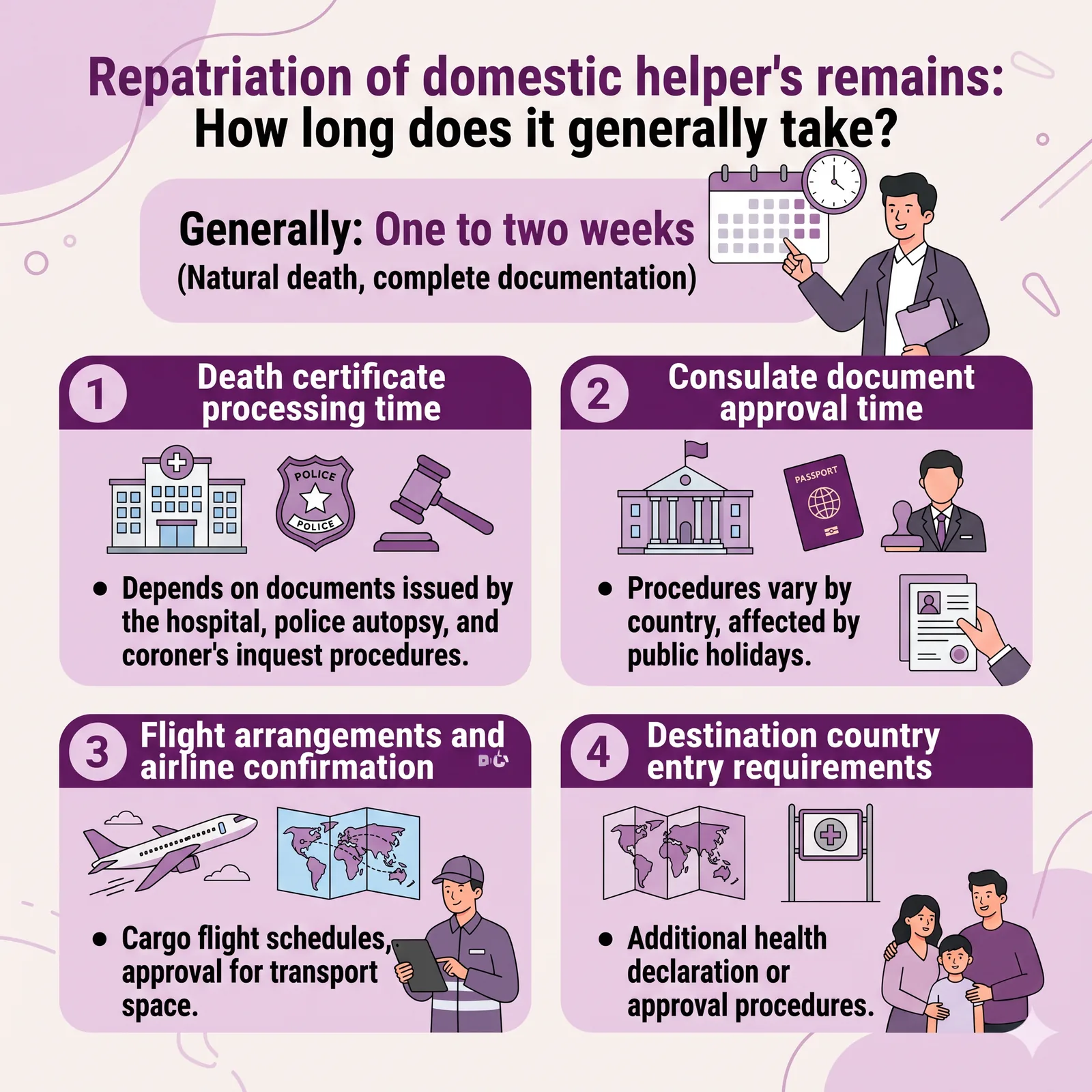
Foreign domestic helper body transportation time varies by case, mainly affected by the following factors:
Death certificate processing time:Depends on the time the hospital issues documents, and whether police autopsy and coroner's court procedures are involved.
Consulate document processing time:Appointment and processing procedures vary in length across different consulates, and public holidays may also cause delays.
Flight arrangements and airline confirmation:Depends on cargo flight frequency to the destination, and airline approval for the remains transport compartment.
Destination country's entry and reception requirements:Some countries may require additional health declarations or approval procedures.
General timeframe reference
Generally speaking, for natural death cases with complete documents, from notifying the funeral company to the remains successfully departing,Approximately one to two weeks.
5. Basic information to prepare before entrusting domestic helper remains transport
To avoid delaying the domestic helper remains transport process, it is recommended that employers prepare in advance:
Deceased's name, nationality, Hong Kong ID card and passport numbers (and copies).
Time, location of death, and hospital name.
Domestic helper's family contact information (home country phone, address, and relationship).
Employer's name, contact information, and ID card copy.
Employment contract copy (if any).
Agency name and contact information (if applicable).
If documents are not complete, you can actually contact the funeral company first and submit the rest gradually; there is no need to wait until everything is ready before starting the process.
Conclusion
In sudden situations like a domestic helper's passing, the greatest difficulty is often not a single procedure, but having to handle multiple contacts and document processing simultaneously. Experienced funeral companies typically assign a dedicated person to follow through the entire process, with the same dedicated team handling all matters to avoid information confusion, and can clearly explain progress and required costs, making it easier for employers to grasp the overall arrangements.
If you are facing such a situation, it is recommended to inquire and obtain professional advice as early as possible; starting the process early will greatly reduce unnecessary time pressure and administrative hassles.
If you wish to learn more, please feel free to contact Paradise for inquiries.
FAQ
Can a domestic helper's body be transported directly by air from Hong Kong to the Philippines/Indonesia?
Yes. Hong Kong International Airport has numerous direct flights to major Southeast Asian cities such as Manila in the Philippines and Jakarta in Indonesia. Our one-stop service prioritizes direct air cargo arrangements to shorten transit time and reduce transshipment risks.
Is embalming a mandatory requirement for air transportation?
Yes. Based on public health safety and the strict guidelines of the International Air Transport Association (IATA), all bodies for cross-border air transport must undergo professional embalming and present an embalming certificate issued by a qualified embalmer.
If the domestic helper died suddenly, and the death certificate takes longer to process, will it affect the transportation arrangements?
Yes. Sudden death cases must be handled by the Coroner. Before obtaining relevant permit documents from the police and the Coroner's Court, the body cannot undergo embalming or exit procedures. During this period, the body must be temporarily stored in a public mortuary, and the overall transportation time will inevitably be delayed.
If the family is overseas, can the funeral company handle all procedures on their behalf?
The vast majority of procedures in Hong Kong can be handled by the funeral company. The family only needs to sign the relevant power of attorney overseas and provide copies of identification documents, and the funeral company can act as a legal agent to handle matters at hospitals, government departments, and consulates.

Comments